 DT
Water intake calculator
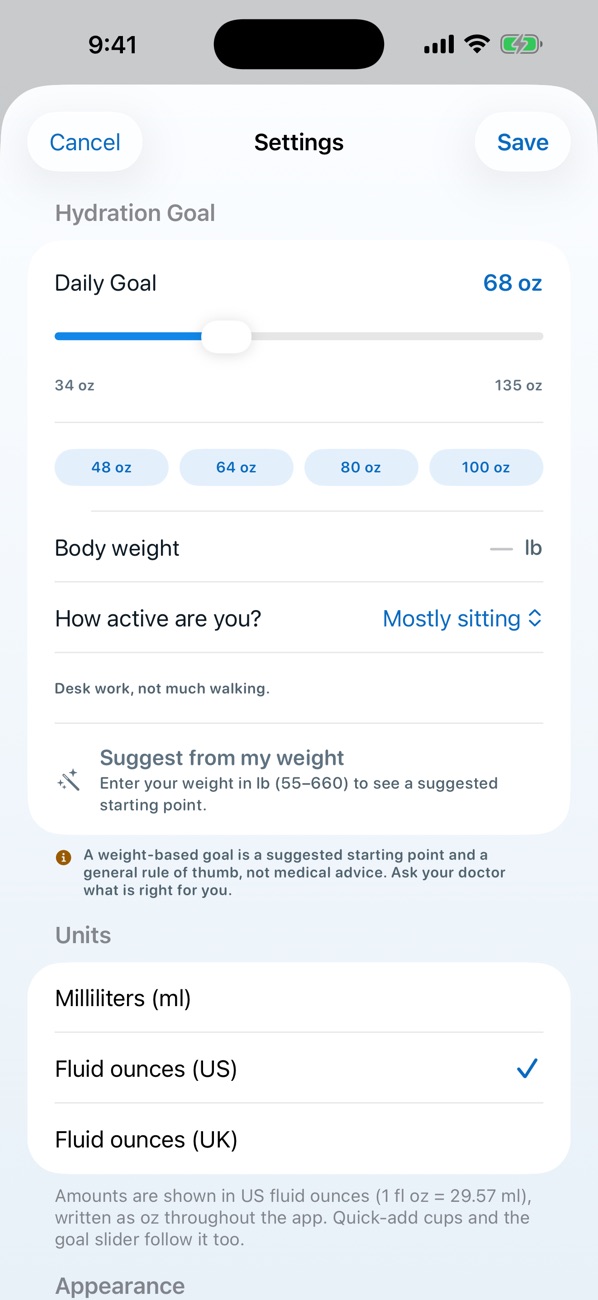
This water intake calculator gives you a daily starting number in ounces, liters and cups from your body weight and activity. It uses a rule of thumb of 35 ml per kilogram, the same one WaterDrop uses for its weight-based suggestion. We did not find a health body that publishes a weight formula, so treat the result as a starting point.
Medical note: This is general information, not advice for you. Ask a clinician about your fluid intake if you have kidney, heart or liver disease, if you take medication that affects fluid balance, or if you were told to limit fluids.
How the calculator works, and which part is official
Two different numbers appear in the result, and they come from different places.
- The official figure. The National Academies report on water says: "The AI for total water intake for young men and women (ages 19 to 30 years) is 3.7 L and 2.7 L per day, respectively." That total includes food. The drinks share it reports is 3.0 L (101 fl oz) for men and 2.2 L (74 fl oz) for women.
- The rule of thumb. 35 ml per kilogram of body weight is a common shortcut, not a published standard. The 10% and 20% activity steps are our own round numbers, so a heavier or more active person sees a larger starting point.
The official figure is an adequate intake based on what healthy people in a US survey drank. It is not a target you must hit, and it does not change with your weight.
- 130 lb divided by 2.205 is 59 kg.
- 59 kg times 35 ml is 2,064 ml, about 2.1 L.
- 2.1 L is about 70 fl oz, or 8.7 cups of 8 fl oz.
- 190 lb divided by 2.205 is 86.2 kg.
- 86.2 kg times 35 ml is 3,016 ml.
- Plus our 20% activity nudge: 3,619 ml, about 3.6 L or 122 fl oz.
Water intake by body weight chart
This chart is the calculator with activity set to mostly sitting, in case you just want to look up your line.
| Body weight | Fluid ounces | Liters | 8 fl oz cups |
|---|---|---|---|
| 100 lb (45 kg) | 54 fl oz | 1.6 L | 6.7 |
| 120 lb (54 kg) | 64 fl oz | 1.9 L | 8.1 |
| 140 lb (64 kg) | 75 fl oz | 2.2 L | 9.4 |
| 160 lb (73 kg) | 86 fl oz | 2.5 L | 10.7 |
| 180 lb (82 kg) | 97 fl oz | 2.9 L | 12.1 |
| 200 lb (91 kg) | 107 fl oz | 3.2 L | 13.4 |
| 220 lb (100 kg) | 118 fl oz | 3.5 L | 14.8 |
| 250 lb (113 kg) | 134 fl oz | 4.0 L | 16.8 |
Using the number in a normal day
A daily number only helps if you can split it up. Divide it by the size of what you actually drink from, then spread it across your waking hours. The guide on how to remember to drink water covers the habit side.
- Result: 86 fl oz a day.
- With a 12 fl oz bottle: 86 divided by 12 is about 7 refills.
- Across a 7 am to 9 pm day, that is one bottle every two hours.
Other drinks count too. Coffee and tea add to your fluids, as does coffee count as water explains, and the NHS says "Water, lower-fat milk and lower-sugar drinks, including tea and coffee, all count as part of your daily intake."
- Goal: 74 fl oz of drinks.
- Two 8 fl oz coffees and a 12 fl oz tea: 28 fl oz.
- Left to drink as water: 46 fl oz, about 6 glasses of 8 fl oz.
- 70 kg times 35 ml is 2,450 ml.
- 2,450 ml is 2.45 L, about 83 fl oz.
- In 250 ml glasses, that is about 10 glasses.
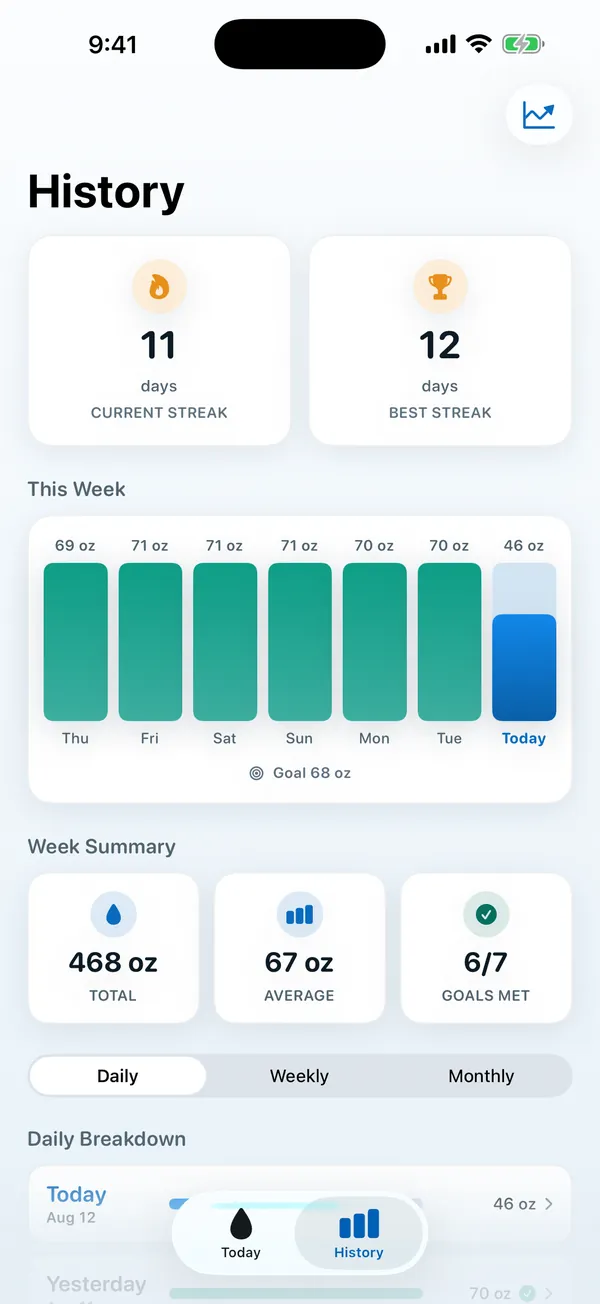
WaterDrop keeps the number for you: log a glass in one tap, and it reminds you when it has been a while. Once you reach your goal, the reminders stop for the day.
When the calculator is wrong for you
A formula cannot see your health. The NHS says you may need more if you are pregnant or breastfeeding, in a hot environment, physically active for long periods, or ill. More is not always better either. The National Academies report warns: "Water intoxication can lead to hyponatremia, which can be life threatening." If you have been told to limit fluids, follow that instead of this page. For the published daily figures in more detail, read how much water should I drink a day.
Why water calculators give different answers
Search for a water calculator and you will get a different number from each one. That is not because one is broken. They measure different things: some count food, some count all drinks, some count only plain water. Here is one person, a 160 lb woman with a desk job, run through four published or common methods.
| Method | What it counts | Her number |
|---|---|---|
| 35 ml per kg rule of thumb | All drinks | 2.5 L (86 fl oz) |
| National Academies, women 19 to 30 | All drinks | 2.2 L (74 fl oz) |
| National Academies, women 19 to 30 | Drinks plus food | 2.7 L (91 fl oz) |
| NHS, 6 to 8 glasses at 8 fl oz | All fluids | 1.4 to 1.9 L (48 to 64 fl oz) |
| Harvard Health, 4 to 6 cups | Plain water only | 0.9 to 1.4 L (32 to 48 fl oz) |
Read side by side, those numbers fit together better than they first appear. The lowest one counts plain water only and assumes the rest comes from coffee, tea, milk and food. When you compare calculators, first check what each one is counting.
Official figures by age and life stage
The National Academies report sets adequate intakes from what people actually consumed in a large US survey. The figures below are total water, from drinks and food together. They are not tied to body weight, which is why our calculator shows them as a comparison and not as your result.
| Group | Total water | Of which drinks |
|---|---|---|
| Children 1 to 3 | 1.3 L | Not listed here |
| Children 4 to 8 | 1.7 L | Not listed here |
| Boys 9 to 13 | 2.4 L | Not listed here |
| Girls 9 to 13 | 2.1 L | Not listed here |
| Boys 14 to 18 | 3.3 L | Not listed here |
| Girls 14 to 18 | 2.3 L | Not listed here |
| Men 19 to 30 | 3.7 L | 3.0 L |
| Women 19 to 30 | 2.7 L | 2.2 L |
| Pregnancy, 19 to 30 | 3.0 L | About 2.3 L |
| Breastfeeding, 19 to 30 | 3.8 L | About 3.1 L |
This calculator is built for adults. Do not use it for a child, and if you are pregnant, read our guide to water intake during pregnancy and talk to your midwife or doctor.
How much of your water comes from food
The report says drinks made up "approximately 81 percent of total water intake in the U.S. survey." So roughly a fifth came from food. You can see it in the figures for men: 3.7 L total minus 3.0 L from drinks leaves 0.7 L.
- Total water for women 19 to 30: 2.7 L.
- From drinks: 2.2 L.
- From food: 2.7 minus 2.2 is 0.5 L.
- So use 2.2 L when you log drinks in an app, because food is not being logged.
What should change your number
The calculator's three activity choices are a rough tool. Real life moves your need in ways no form can see.
- Exercise and sweat. Harvard Health notes you should drink more if you lose water through sweat. Sweat varies widely, so treat the 20% step as a starting guess, and drink more on a long hot run.
- Hot or dry air. The National Academies report says breathing hot, dry air during intense exercise "can increase respiratory water losses by 120 to 300 mL/day", on top of sweat.
- Illness. The NHS lists being ill or recovering from illness as a reason to drink more. If you have vomiting or diarrhea and cannot keep fluids down, get medical advice.
- Medication and health conditions. Harvard Health says certain health conditions and medications influence your daily total. Some conditions call for less water, not more.
- 170 lb divided by 2.205 is 77.1 kg.
- 77.1 times 35 ml is 2,699 ml, about 91 fl oz.
- With the 20% step: 3,239 ml, about 110 fl oz.
- In 16.9 fl oz bottles: 110 divided by 16.9 is about 6.5 bottles.
Does coffee count toward the result?
Yes. The NHS counts tea and coffee as part of your daily intake. The old worry was that caffeine dehydrates you, and the National Academies report says of it: "available data are inconsistent." It did not treat caffeinated drinks as something to exclude. The details are in does coffee count as water.
How to check the number against your body
A calculator gives you a place to start, and your body gives you feedback. The National Academies report says day-to-day intake, "driven by the combination of thirst and the consumption of beverages at meals, allows maintenance of hydration status" for healthy people. It also notes "urine color has been used as an indicator of hydration status". The NHS version of the test is simple: you should be drinking enough that your pee is a "clear pale yellow colour."
- Days 1 to 3: log what you already drink, with no goal. Say the average is 50 fl oz.
- Days 4 to 7: aim for 60 fl oz, not the full calculator number.
- Week 2: move to 70 fl oz, then the calculator's 86 fl oz if it feels fine.
- If you are up at night to use the bathroom, move more of it to the morning.
- Settle on what keeps you comfortable, even if it differs from the number here.
Is there an upper limit?
There is no official daily cap, but that does not mean more is always fine. The report says "a Tolerable Upper Intake Level (UL) was not set for water" because healthy people can excrete a large excess. The danger is drinking a lot in a short time, and in people whose kidneys, heart or liver limit how much water they can clear. A calculator result is never a reason to force fluids when you feel full or sick. Spread drinks out across the day.
Questions people ask
How do I calculate my daily water intake?
A common rule of thumb is 35 ml per kilogram of body weight. At 160 lb, or 72.6 kg, that is about 2.5 L or 86 fl oz. It is a starting point, not a medical figure. We did not find a health body that publishes a weight formula.
Is the calculator result only plain water?
It covers all drinks. Coffee, tea and milk count toward your fluids, and food adds water on top. The National Academies total of 2.7 L for women and 3.7 L for men includes food, with about 2.2 L and 3.0 L coming from drinks.
Does body weight change how much water I need?
The official figures do not change with weight, because they come from what healthy people in a survey drank. The weight-based number is a popular shortcut that gives larger people a larger starting point. Use it as a first guess and adjust.
Can the calculator tell me if I drink too much?
No. It gives a starting number and cannot see your health. Very high intakes can cause hyponatremia, which the National Academies report calls life threatening. If you have kidney, heart or liver disease, ask your clinician what amount is right.
Sources
- National Academies: Dietary Reference Intakes, Water
- NHS: Water, drinks and hydration
- Harvard Health: How much water should you drink?
Guides
- Choosing a water reminder app for iPhoneHow to pick the best water reminder app for iPhone: ratings measured on the App Store today, plus the six things that decide whether you keep using it.
- Does coffee count as water intake?Yes, coffee counts toward your daily water. The evidence, the caffeine limit, a verdict for every order from black to bulletproof, and seven counted days.
- How many ounces is a glass of water?How many ounces is a glass of water? 8 fl oz by convention, but real glasses vary. See a size table, how to measure yours and what 8 glasses means.
- How much is 3 liters of water?How much is 3 liters of water? 101.4 fl oz, 12.7 cups or 6 standard bottles. See the conversion table, a sample day and who it suits.
- How much water should I drink a day?How much water should you drink a day? The intakes health bodies publish, in litres and ounces, why 8 glasses is a rule of thumb, and when to drink more.
- How to remember to drink waterTie water to cues you already have, then add reminders that stop when you are done. Eight setups with times and amounts: cues, Siri, bottle, app.
- A Plant Nanny alternativeLooking for a Plant Nanny alternative? Compare water trackers by their own listings, what to try before you switch, and how to move across.
- Smart water bottle or app?A smart water bottle measures what passes through it, and an app counts every drink you log. Compare them, and see when a bottle is worth buying.
- How much water to drink when pregnantACOG's 8 to 12 cups a day, the National Academies' liters, and seven pregnancy drinking plans with clock times in ounces and milliliters.
- A Waterllama alternativeLooking for a Waterllama alternative? Compare other iPhone water trackers by their own listings, and see when you should simply stay with Waterllama.