 DT
18:6 intermittent fasting: schedules and how to start
18:6 intermittent fasting means you fast for 18 hours and eat within a 6-hour window. If you finish dinner at 7:00 pm, your fast ends at 1:00 pm the next day, and your window runs from 1:00 pm to 7:00 pm. It is one step tighter than 16:8, and we found no good evidence that the tighter window works better.
Below are sample schedules, a comparison with other plans, who should avoid it and how to work up to it. Written by the DT Nova team, the studio that makes FastTrack.
Medical note: This is general information, not advice for you. Ask a clinician before fasting if you are pregnant or breastfeeding, or have diabetes. The same goes for medication that must be taken with food, or a history of an eating disorder. If your fast is for a lab test, the instructions from whoever ordered the test override this page.
Sample 18:6 schedules
| Last meal finished | Fast ends | Eating window |
|---|---|---|
| 7:00 pm | 1:00 pm | 1:00 pm to 7:00 pm |
| 8:00 pm | 2:00 pm | 2:00 pm to 8:00 pm |
| 6:00 pm | 12:00 pm | 12:00 pm to 6:00 pm |
| 3:00 pm | 9:00 am | 9:00 am to 3:00 pm |
| 11:00 pm | 5:00 pm | 5:00 pm to 11:00 pm |
Pick a window based on your real day. Cleveland Clinic suggests planning your fast "to begin at least three hours before bedtime", and says it is important for "the majority of your calories" to be "taken in before it's dark out". Use the intermittent fasting calculator for any other start time.
What a day looks like
- 7:00 am: black coffee or tea, and water.
- 1:00 pm: lunch, your first meal.
- 3:30 pm: a snack, if you want one.
- 6:30 pm: dinner, finished by 7:00 pm.
- 7:00 pm: the next fast begins.
- 3:00 pm the day before: last meal finished.
- 9:00 am: breakfast.
- 1:00 pm: lunch, finished by 3:00 pm.
- This fits some early starters, but it does mean no family dinner.
How 18:6 compares with other schedules
| Schedule | Eating window | Fasting per week | Meals that fit |
|---|---|---|---|
| 14:10 | 10 hours | 98 hours | 2 or 3 |
| 16:8 | 8 hours | 112 hours | 2 or 3 |
| 18:6 | 6 hours | 126 hours | 2 |
| 20:4 | 4 hours | 140 hours | 1 large, 1 small |
| OMAD 23:1 | About 1 hour | 161 hours | 1 |
Longer is not automatically better. Harvard's review says it is "unclear that intermittent fasting is superior to other weight loss methods in regards to amount of weight loss, biological changes, compliance rates, and decreased appetite." It also describes a trial where time-restricted eating and unrestricted eating, on the same calorie restriction, were "not significantly different among the groups." So a shorter window is not proven to work better than a longer one. Pick the one you can keep up.
What the evidence does and does not show
Most fasting research studies other patterns, or compares fasting with ordinary dieting, and we did not find strong long-term research on this exact window. Harvard still lists "What are the long-term effects of intermittent fasting?" as an unanswered question. The closest trial we use is the small Stote pilot study, in which food was "eaten within a 4-h period in the early evening". It found reduced fat mass, but also a "significant increase in hunger" and "significant increases in blood pressure and in total, LDL-, and HDL-cholesterol concentrations". That was in healthy, normal-weight adults, and it was built to hold weight steady, so it does not tell you what will happen to you. It's a reason to be careful with big promises about any tight window.
Who should not try 18:6
Harvard's review says people with diabetes, eating disorders that involve self-restriction, or who use medication that requires food should abstain from intermittent fasting. So should adolescents and people who are pregnant or breastfeeding. Cleveland Clinic adds that you should "be cautious if you’re experiencing perimenopause". If you are unsure, ask your clinician before you begin.
How to work up to 18:6
You do not need to start here. If you can't yet manage a shorter fast easily, a longer one won't feel better. Moving the window a bit at a time gives you room to notice how you feel.
- Week 1: 14:10, eating 9:00 am to 7:00 pm.
- Week 2: 16:8, eating 11:00 am to 7:00 pm.
- Week 3: 18:6, eating 1:00 pm to 7:00 pm.
- Stay on any step for longer if it isn't comfortable. You can also stop there.
What to eat in a 6-hour window
With fewer hours, each meal has to do more, and it's easier to fall short on food without noticing. Plan protein and vegetables first. Our guide to the best foods to break a fast has plates with USDA numbers, and it applies to any window.
- 1:00 pm: 150 g cooked salmon (309 calories, 33 g protein) with 60 g dry rice (219 calories) and broccoli.
- 6:30 pm: 100 g roasted chicken (165 calories, 31 g protein), 200 g lentils (232 calories, 18 g protein) and vegetables.
- That's about 925 calories before oils and sides, so most people would need more.
- Add fruit, nuts, yogurt or a larger portion to fit your needs.
Is the extra two hours worth it?
Going from 16:8 to 18:6 usually means pushing your first meal back two hours. On paper that is 14 more fasting hours a week. In practice, it may just mean lunch at 1:00 pm in place of 11:00 am, which many people barely notice, or it may mean a hungry, grumpy late morning. You can find out by trying it for two weeks and writing down how the last two hours feel.
- Weeks 1 and 2 on 16:8: log how many days you reach your window.
- Weeks 3 and 4 on 18:6: log the same thing.
- Fewer days reached on 18:6? Go back. The schedule you actually keep is the better one.
What you can have during the fast
The Cleveland Clinic guide says: "Zumpano says water, carbonated water, black coffee and unsweetened teas are all acceptable when fasting." For anything else, see what breaks a fast. Keep drinking through the day, since fewer meals also means less water from food.
Common problems, and what to try
- You keep breaking the fast at the same time of day. Move your window so it opens just before that time. That is a schedule problem and not a willpower problem.
- Your social life keeps getting in the way. Move the window on those days, or shorten your fast. Treat a plan as something that serves you.
- You feel unwell. Dizziness, faintness or feeling out of control around food are reasons to stop, go back to a shorter window and talk to a clinician.
- You have been at it for weeks with no change you care about. Think about whether fasting suits you at all. There are other ways to eat well.
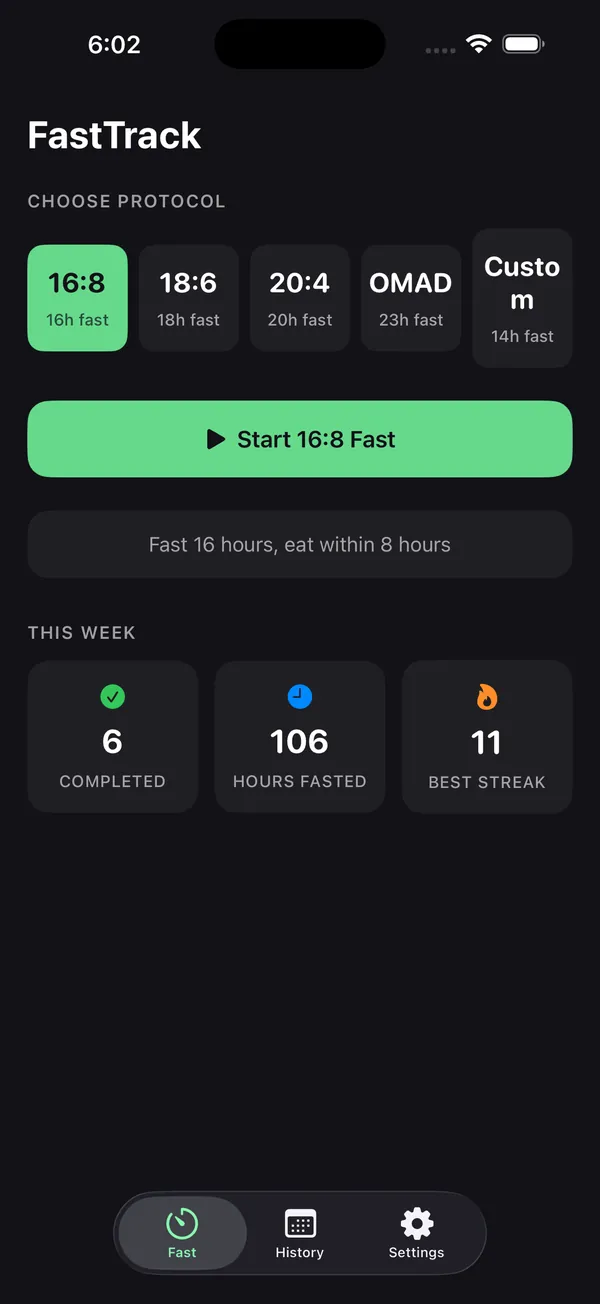
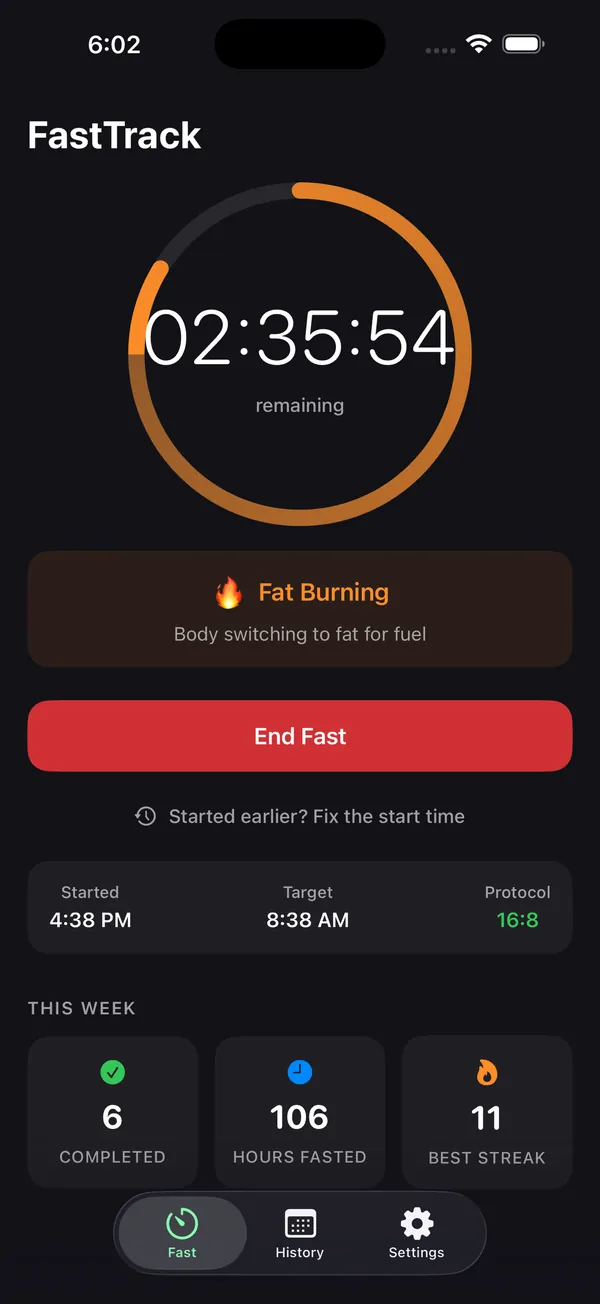
FastTrack runs a 18:6 timer for free with a live countdown, and you can fix a wrong start time afterward. Your history stays on your device, with no account.
Questions people ask
What does 18:6 intermittent fasting mean?
You fast for 18 hours and eat within 6 hours, every day or most days. If your last meal ends at 7:00 pm, the fast ends at 1:00 pm next day, and you eat between 1:00 pm and 7:00 pm.
Is 18:6 better than 16:8?
We did not find good evidence that it is. Harvard's review says it's unclear intermittent fasting beats other weight loss methods. The shorter window may be harder to keep, so the better schedule is the one you can stick with.
What can I drink during an 18-hour fast?
Water, carbonated water, black coffee and unsweetened tea are all listed by Cleveland Clinic as acceptable. Anything with calories, like milk or juice, ends a strict fast.
How many meals can I eat on 18:6?
Usually two, with perhaps a snack. For example, a meal at 1:00 pm and another at 6:30 pm. Plan them so you get enough food, since you have fewer chances to eat.
Sources
- Cleveland Clinic: Intermittent fasting, 4 different types
- Harvard T.H. Chan: Diet Review, Intermittent Fasting
- Stote et al.: A controlled trial of reduced meal frequency
Guides
- A 16:8 intermittent fasting scheduleA 16:8 intermittent fasting schedule with clock times for early risers, 9-to-5, night shifts and weekends, a 12:12 ramp-up week and what the evidence says.
- 20:4 intermittent fasting20:4 intermittent fasting means fasting 20 hours and eating within 4. See sample schedules, how it differs from OMAD, the evidence and who should avoid it.
- Best foods to break a fastThe best foods to break a fast are ordinary: protein, fiber and whole grains. See three meals with USDA numbers, what to limit and long-fast cautions.
- Does bone broth break a fast?Does bone broth break a fast? Under a strict rule, yes: it has calories and protein. See USDA figures, how to read a carton, and when to drink it instead.
- Does coffee break a fast?Does coffee break a fast? An order-by-order table for black coffee, milk, latte, cream, bulletproof and sweeteners, with USDA calories and worked mornings.
- Does creatine break a fast?Does creatine break a fast? Plain creatine is unlikely to, but gummies, flavored powders and pre-workouts can. How to read the label and when to take it.
- Does gum break a fast?Does gum break a fast? Sugared gum does, and sugar-free gum is a gray area with a few calories and sweeteners. See the label math and what to use instead.
- Does lemon water break a fast?Does lemon water break a fast? A wedge is about 1 calorie and a whole lemon about 11. See the USDA table, strict and relaxed rules, and the lab exception.
- Does stevia break a fast?Does stevia break a fast? Pure stevia has almost no calories, but it is still a gray area and packets often hide fillers. How to read the label and decide.
- A fasting app without a subscription wallLooking for a fasting app without a subscription? What a free intermittent fasting tracker should include, the traps, and what FastTrack keeps free.
- Fasting before blood workFasting before blood work: which tests need it, the hours Labcorp, Quest and MedlinePlus give, and seven timelines from your last meal to the draw.
- Intermittent fasting calculatorA free intermittent fasting calculator: pick 16:8, 18:6, 20:4 or OMAD, enter your last meal, and see when your fast ends and your window opens.
- Keto and intermittent fastingKeto and intermittent fasting can be combined, but no strong evidence shows it's better. See what each does, a sample day, risks and who should avoid it.
- OMAD: one meal a dayOMAD means eating one meal a day and fasting 23 hours. What the trial really found, who should avoid it, a sample day and a plate with real numbers.
- A Simple fasting app alternativeLooking for a Simple fasting app alternative? Compare apps by their own listings, what you give up without a coach, and how to cancel and move across.
- What breaks a fast?What breaks a fast? Anything with calories, by the strict rule. See one table of drinks, sweeteners and supplements, plus what to do if you slip up.
- A Zero fasting app alternativeLooking for a Zero fasting app alternative? What Zero includes free and in Zero Plus, by its own App Store listing, next to FastTrack's free tier.