 DT
What breaks a fast? The full table
What breaks a fast? Under the strict rule, anything with calories does. Water, sparkling water, black coffee and unsweetened tea do not. Everything else falls into a gray area that depends on your label and on why you are fasting, and a lab fast has stricter rules still.
Below is a single table of the common foods, drinks and supplements, with links to a fuller guide where we have one. We rely on the Cleveland Clinic rule and USDA arithmetic. Where no one has measured something, we say so. Put together by the DT Nova team, makers of FastTrack.
Medical note: This is general information, not advice for you. Ask a clinician before fasting if you are pregnant or breastfeeding, or have diabetes. The same goes for medication that must be taken with food, or a history of an eating disorder. If your fast is for a lab test, the instructions from whoever ordered the test override this page.
What breaks a fast: the full table
| Item | Strict fast | Why |
|---|---|---|
| Water, sparkling water | Fine | No calories; Cleveland Clinic lists them |
| Black coffee, plain tea | Fine | Cleveland Clinic lists them; coffee guide |
| Coffee with milk, cream or sugar | Breaks it | Calories |
| Lemon in water | Technically breaks it | About 1 calorie a wedge; lemon guide |
| Sugar-free gum | Gray area | A few calories and sweeteners; gum guide |
| Stevia | Gray area | Almost no calories, but a sweetener; stevia guide |
| Diet soda | Gray area | Sweeteners Cleveland Clinic says to limit |
| Plain creatine | Likely fine | Check the label; creatine guide |
| Bone broth | Breaks it | Calories and protein; broth guide |
| Collagen or protein powder | Breaks it | Protein is calories |
| Juice, smoothie, milk | Breaks it | Calories and sugar |
| Alcohol | Breaks it | Calories |
The rule behind the table
Cleveland Clinic says: "To maintain a fasting state, you must not consume any foods or drinks with calories." It goes on: "Zumpano says water, carbonated water, black coffee and unsweetened teas are all acceptable when fasting." That is a clear and simple line, and we use it here because it is easy to follow. Note that it is a practical rule from a hospital's guide, and not a measurement of what happens in your body at each calorie. You will see people online quoting a "50 calorie rule". We could not find a source that supports that as a real threshold, so we do not use it.
Why different people give different answers
"Breaks a fast" means different things depending on your reason for fasting, and that's why the arguments never end.
- You want a simple eating window. Then a small amount of something rarely changes your routine, and the rule is mostly about habits.
- You follow a specific program. Use its own definition, since programs differ.
- You are fasting for a blood test. Follow the lab. Labcorp says: "Plain water is always encouraged."
- You are curious about a specific biological effect. We do not have a measured calorie threshold to offer you. Be skeptical of anyone giving you an exact number.
- 7:00 am: black coffee. Both rules: fine.
- 9:00 am: a wedge of lemon in water, about 1.3 calories. Strict: no. Relaxed: yes.
- 10:30 am: one stick of sugar-free gum. Strict: no. Relaxed: your call.
- 11:00 am: a splash of oat milk. Both rules: this is food, so it ends the fast.
How to read a label in 20 seconds
Most questions are answered on the package. Look at three lines, in this order.
- Calories per serving. Under 21 CFR 101.60, a zero-calorie claim can mean "less than 5 calories per reference amount customarily consumed".
- Serving size. A bottle might hold more than one serving. Multiply.
- Ingredients. Look for sugar, honey, syrup, juice, sugar alcohols and sweeteners like sucralose, aspartame or stevia.
- Label: 10 calories per 8 fl oz, and the can holds 16 fl oz.
- That is 2 servings, so 20 calories in the can.
- Sweetened with sucralose, too.
- Strict fast: no. It has both calories and a sweetener Cleveland Clinic says to limit.
- Whole milk, by USDA figures: 61 calories per 100 g, and a tablespoon is 15 g.
- One tablespoon is about 9 calories.
- Three coffees with a tablespoon each: about 27 calories.
- Small on its own, but it does end a strict fast the first time.
Supplements and medication
Plain vitamins in capsules contain few or no calories, but gummy vitamins usually contain sugar. Some supplements upset an empty stomach, and some are better absorbed with food, so you may want to move them to your eating window. Check the label for any instructions on food. Never skip or move prescription medication to fit a fast without asking your prescriber. Harvard's review says people using medication that requires food should abstain from intermittent fasting altogether.
What to do when you break a fast by accident
It happens. You had a bite of something, or milk went into the coffee out of habit. There is no penalty and no need to start over. Decide what is useful.
- You were on 16:8, fasting from 8:00 pm to 12:00 pm.
- A biscuit at 10:00 am ends a strict fast at 14 hours.
- Option 1: count it as a 14-hour fast, and eat normally from noon.
- Option 2: restart the clock if you are working to a stricter plan. Neither is a failure.
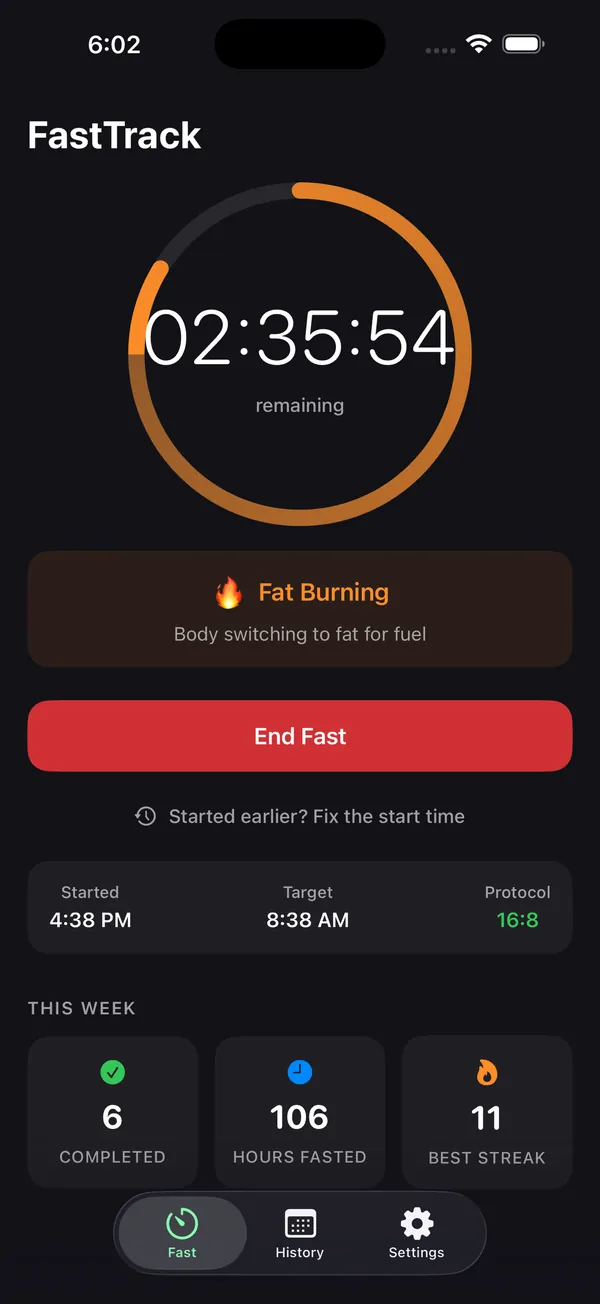
FastTrack lets you edit a past fast for free, so your log can say what really happened. That is usually more useful than a perfect-looking streak.
Common myths about breaking a fast
- "Taking a pill breaks your fast." A plain tablet with water has no real calories. Ask your pharmacist about coated, chewable or liquid forms, which may contain sugar.
- "Brushing your teeth breaks your fast." You spit out the toothpaste, so it's not a concern for an ordinary fast. For a lab test, ask your lab.
- "Zero calories means it's fine." Zero can mean under 5 per serving, and it says nothing about sweeteners.
- "Black coffee breaks your fast." Not by the Cleveland Clinic list. It's a different story for a blood test, where Labcorp says you "should avoid coffee even if it's black with no sugar or cream".
Keep your own rule short
You will fast more easily with a rule that fits on one line, such as "water, black coffee and plain tea only" or "those, plus lemon". Decide it once, and you don't have to debate it every morning. Harvard's review says it is "unclear that intermittent fasting is superior to other weight loss methods", so the fine detail of a wedge of lemon is unlikely to be the thing that decides your results. For help with the timing part, try the intermittent fasting calculator, and when your window opens, see the best foods to break a fast.
Questions people ask
How many calories break a fast?
By the strict rule, any. Cleveland Clinic says you must not consume foods or drinks with calories. We could not find a source supporting a threshold like 50 calories, so treat those numbers with caution.
Do electrolytes break a fast?
Plain electrolytes with no sugar or calories don't add energy, and Cleveland Clinic suggests considering them. Many mixes contain sugar or sweeteners, so read the label. Ask a clinician if you have heart or kidney disease or high blood pressure.
Does medication break a fast?
Don't change prescribed medication to fit a fast without asking your prescriber. Harvard's review says people whose medication requires food should abstain from intermittent fasting. Liquid or chewable forms may contain sugar, so ask your pharmacist.
What happens if I accidentally break my fast?
Nothing dramatic. Log what happened, and carry on with your eating window, or start your next fast as planned. One slip doesn't undo anything worth worrying about, and you don't have to start over.
Sources
- Cleveland Clinic: Intermittent fasting, 4 different types
- Harvard T.H. Chan: Diet Review, Intermittent Fasting
- 21 CFR 101.60: Nutrient content claims for calorie content
- Labcorp: Fasting before a lab test
- USDA: Whole milk
Guides
- A 16:8 intermittent fasting scheduleA 16:8 intermittent fasting schedule with clock times for early risers, 9-to-5, night shifts and weekends, a 12:12 ramp-up week and what the evidence says.
- 18:6 intermittent fasting18:6 intermittent fasting means fasting 18 hours and eating in a 6-hour window. See sample schedules, how it compares to 16:8, and who should avoid it.
- 20:4 intermittent fasting20:4 intermittent fasting means fasting 20 hours and eating within 4. See sample schedules, how it differs from OMAD, the evidence and who should avoid it.
- Best foods to break a fastThe best foods to break a fast are ordinary: protein, fiber and whole grains. See three meals with USDA numbers, what to limit and long-fast cautions.
- Does bone broth break a fast?Does bone broth break a fast? Under a strict rule, yes: it has calories and protein. See USDA figures, how to read a carton, and when to drink it instead.
- Does coffee break a fast?Does coffee break a fast? An order-by-order table for black coffee, milk, latte, cream, bulletproof and sweeteners, with USDA calories and worked mornings.
- Does creatine break a fast?Does creatine break a fast? Plain creatine is unlikely to, but gummies, flavored powders and pre-workouts can. How to read the label and when to take it.
- Does gum break a fast?Does gum break a fast? Sugared gum does, and sugar-free gum is a gray area with a few calories and sweeteners. See the label math and what to use instead.
- Does lemon water break a fast?Does lemon water break a fast? A wedge is about 1 calorie and a whole lemon about 11. See the USDA table, strict and relaxed rules, and the lab exception.
- Does stevia break a fast?Does stevia break a fast? Pure stevia has almost no calories, but it is still a gray area and packets often hide fillers. How to read the label and decide.
- A fasting app without a subscription wallLooking for a fasting app without a subscription? What a free intermittent fasting tracker should include, the traps, and what FastTrack keeps free.
- Fasting before blood workFasting before blood work: which tests need it, the hours Labcorp, Quest and MedlinePlus give, and seven timelines from your last meal to the draw.
- Intermittent fasting calculatorA free intermittent fasting calculator: pick 16:8, 18:6, 20:4 or OMAD, enter your last meal, and see when your fast ends and your window opens.
- Keto and intermittent fastingKeto and intermittent fasting can be combined, but no strong evidence shows it's better. See what each does, a sample day, risks and who should avoid it.
- OMAD: one meal a dayOMAD means eating one meal a day and fasting 23 hours. What the trial really found, who should avoid it, a sample day and a plate with real numbers.
- A Simple fasting app alternativeLooking for a Simple fasting app alternative? Compare apps by their own listings, what you give up without a coach, and how to cancel and move across.
- A Zero fasting app alternativeLooking for a Zero fasting app alternative? What Zero includes free and in Zero Plus, by its own App Store listing, next to FastTrack's free tier.