 DT
Intermittent fasting calculator
This intermittent fasting calculator shows when your fast ends and when your eating window runs. Pick a schedule, enter when you finish your last meal, and it does the clock math in your local time. It calculates time only, not calories or weight.
Medical note: This is general information, not advice for you. Ask a clinician before fasting if you are pregnant or breastfeeding, or have diabetes. The same goes for medication that must be taken with food, or a history of an eating disorder. If your fast is for a lab test, the instructions from whoever ordered the test override this page.
How the calculator works
The math is simple: your last meal time plus your fasting hours is when the fast ends, and the eating window runs until 24 hours after your last meal. The Cleveland Clinic guide describes the 16/8 and 14/10 methods as set fasting times with "specific windows where you can eat", and Harvard's Nutrition Source describes time-restricted eating in the same way.
- 8:00 pm plus 16 hours: 12:00 pm next day.
- Eating window: 12:00 pm to 8:00 pm.
- Coffee or water in the morning, first meal at noon.
- 7:00 pm plus 18 hours: 1:00 pm next day.
- Eating window: 1:00 pm to 7:00 pm.
- 6:30 pm plus 20 hours: 2:30 pm next day.
- Eating window: 2:30 pm to 6:30 pm.
Common schedules with an 8:00 pm last meal
| Schedule | Last meal | Fast ends | Eating window ends |
|---|---|---|---|
| 12:12 | 8:00 pm | 8:00 am | 8:00 pm |
| 14:10 | 8:00 pm | 10:00 am | 8:00 pm |
| 16:8 | 8:00 pm | 12:00 pm | 8:00 pm |
| 18:6 | 8:00 pm | 2:00 pm | 8:00 pm |
| 20:4 | 8:00 pm | 4:00 pm | 8:00 pm |
| OMAD 23:1 | 8:00 pm | 7:00 pm | 8:00 pm |
For a full walkthrough of the most common plan, see the 16:8 intermittent fasting schedule. If you want to go down to one meal, read OMAD, one meal a day.
Fitting a schedule to real life
Pick the window that fits your day, because the one you can keep is the useful one. The calculator works for any shift pattern.
- 11:30 pm plus 16 hours: 3:30 pm next day.
- Eating window: 3:30 pm to 11:30 pm.
- Current 16:8: eat 12:00 pm to 8:00 pm.
- Finish tonight's meal at 7:00 pm instead.
- Tomorrow's fast ends at 11:00 am, and your window is 11:00 am to 7:00 pm.
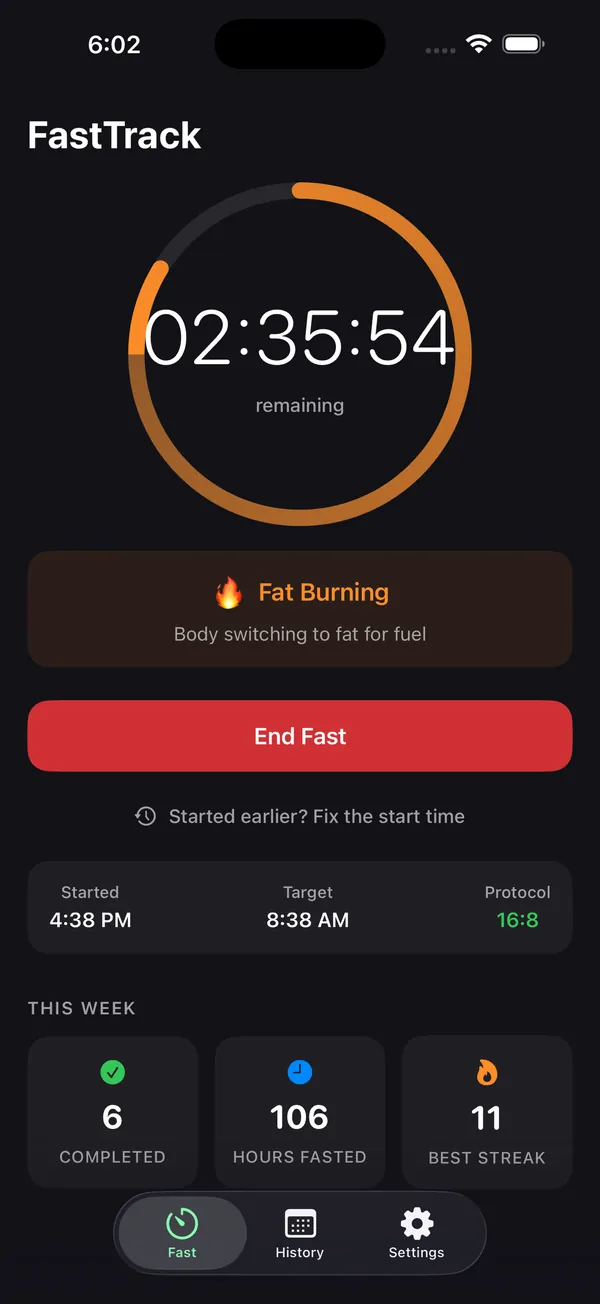
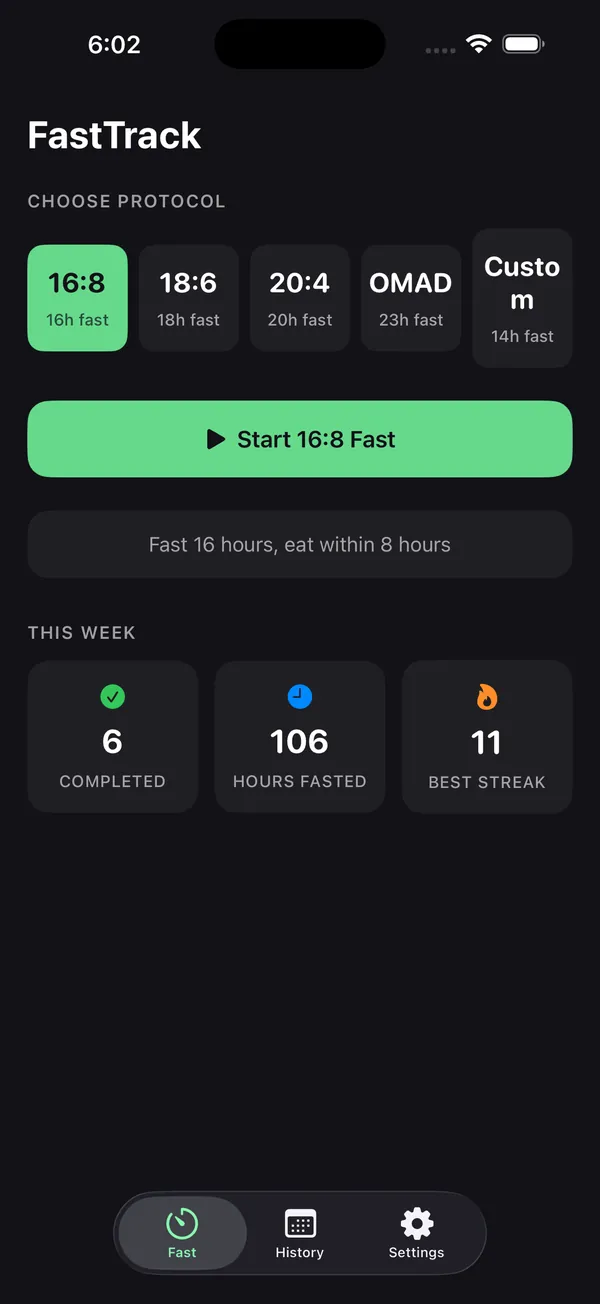
FastTrack runs this on your iPhone. The free timers cover 16:8, 18:6 and 20:4, and you can fix a wrong start time afterward. OMAD and custom windows are Premium.
What this calculator does not tell you
It does not predict weight loss or tell you that fasting is right for you. Harvard's review says people with diabetes, eating disorders, or who use medication that requires food should abstain, as should adolescents and people who are pregnant or breastfeeding. It also still lists "What are the long-term effects of intermittent fasting?" as an unanswered question. If your fast is for a blood test, follow your lab's rules and see fasting before blood work.
What each schedule asks of you
The two numbers in a schedule are hours fasting and hours eating, and they always add up to 24. This table shows what each one adds up to over a week.
| Schedule | Fasting each day | Eating window | Fasting per week |
|---|---|---|---|
| 12:12 | 12 hours | 12 hours | 84 hours |
| 14:10 | 14 hours | 10 hours | 98 hours |
| 16:8 | 16 hours | 8 hours | 112 hours |
| 18:6 | 18 hours | 6 hours | 126 hours |
| 20:4 | 20 hours | 4 hours | 140 hours |
| OMAD 23:1 | 23 hours | 1 hours | 161 hours |
The jump from 12:12 to 16:8 is 28 more fasting hours a week, and most of it is skipping or delaying one meal. The jump from 20:4 to OMAD changes less on the clock, but you go from a window to a single sitting.
When does the clock start?
Your fast starts when you finish your last food or drink with calories, not when you sit down to dinner and not when you go to bed. That is why the calculator asks when you finish. The Cleveland Clinic guide says: "To maintain a fasting state, you must not consume any foods or drinks with calories." So a late snack at 9:30 pm moves your whole next day.
- Planned: dinner ends at 8:00 pm, fast ends at 12:00 pm.
- A snack at 9:30 pm restarts the count.
- 9:30 pm plus 16 hours is 1:30 pm next day.
- Your choice: eat at 1:30 pm, or accept a 14.5-hour fast at noon. Neither is a failure.
Choosing where to put your window
The calculator works from your last meal, so moving that meal moves everything. A few common patterns are below, and each is a real option rather than a recommendation. Harvard's review describes a time-restricted example where "Meals are eaten from 8am-3pm", which shows an early window is a normal version of this.
| Pattern | Eating window | Fast ends | Good for |
|---|---|---|---|
| Early | 8:00 am to 4:00 pm | 8:00 am | Breakfast people |
| Midday | 10:00 am to 6:00 pm | 10:00 am | Early dinners |
| Standard | 12:00 pm to 8:00 pm | 12:00 pm | Family dinner |
| Late | 3:30 pm to 11:30 pm | 3:30 pm | Evening shifts |
Does an early window beat a late one? Our sources do not settle that. Harvard describes one trial where people with obesity followed the same moderate calorie restriction, and one group could eat only from 8am to 4pm. It reports the changes in weight and other measures "were not significantly different among the groups."
- Weekdays, 16:8: dinner ends 7:30 pm, fast ends 11:30 am.
- Saturday dinner out ends at 10:00 pm.
- Sunday fast ends at 2:00 pm if you keep 16 hours.
- Or end it at 12:00 pm, which is a 14-hour fast. A shorter day now and then is fine for most routines.
Shifts, time zones and clock changes
The calculator uses your device's local time, and it counts forward from your last meal, so a window that crosses midnight works normally.
- Night shifts. Enter your real last meal, even if it is at 5:00 am. The fast then runs through your sleep in the daytime.
- Flying across time zones. Count hours from your last meal, not the local clock. If you ate at 7:00 pm in New York and land in London, the 16 hours are still 16 hours.
- Clock changes. The calculator does simple clock arithmetic and does not know about daylight saving. On the night the clocks change, the result can be an hour off.
- Last meal finished at 5:00 am after work.
- 5:00 am plus 18 hours is 11:00 pm.
- Eating window: 11:00 pm to 5:00 am, during your shift.
Common mistakes with fasting windows
- Starting at the longest schedule. Longer is not a goal in itself. Harvard's review says it is "unclear that intermittent fasting is superior to other weight loss methods".
- Counting drinks with calories as fasting. Milk, sugar and juice count. Our guides on coffee and lemon water go through the details.
- Treating a short fast as a failed one. A 14-hour day in a 16-hour plan still counts as a 14-hour fast. Log the real number and keep going.
- Using this for a lab test. A blood test fast follows the instructions from your lab, not this calculator.
Questions people ask
How do I calculate my intermittent fasting window?
Add your fasting hours to the time you finish your last meal. That is when the fast ends. On 16:8 with a last meal at 8:00 pm, the fast ends at 12:00 pm and you eat until 8:00 pm.
What is the best intermittent fasting schedule?
There is no single best one. Pick the window you can keep with your work and family meals. The Cleveland Clinic says it might take some trial and error first. A shorter fast like 12:12 or 14:10 is a gentler first step than 16:8.
Does this calculator tell me how much weight I will lose?
No. It only does clock math. Weight results depend on many things, and predictions from a timer would be guesswork. Harvard's review lists long-term effects of intermittent fasting as an open question.
What if I finish my last meal later than planned?
Enter the real time. Your fast then ends later by the same amount. In FastTrack you can also fix the start time after the fact, so your history stays accurate.
Sources
- Cleveland Clinic: Intermittent fasting, 4 different types
- Harvard T.H. Chan: Diet Review, Intermittent Fasting
- Stote et al.: A controlled trial of reduced meal frequency
Guides
- A 16:8 intermittent fasting scheduleA 16:8 intermittent fasting schedule with clock times for early risers, 9-to-5, night shifts and weekends, a 12:12 ramp-up week and what the evidence says.
- 18:6 intermittent fasting18:6 intermittent fasting means fasting 18 hours and eating in a 6-hour window. See sample schedules, how it compares to 16:8, and who should avoid it.
- 20:4 intermittent fasting20:4 intermittent fasting means fasting 20 hours and eating within 4. See sample schedules, how it differs from OMAD, the evidence and who should avoid it.
- Best foods to break a fastThe best foods to break a fast are ordinary: protein, fiber and whole grains. See three meals with USDA numbers, what to limit and long-fast cautions.
- Does bone broth break a fast?Does bone broth break a fast? Under a strict rule, yes: it has calories and protein. See USDA figures, how to read a carton, and when to drink it instead.
- Does coffee break a fast?Does coffee break a fast? An order-by-order table for black coffee, milk, latte, cream, bulletproof and sweeteners, with USDA calories and worked mornings.
- Does creatine break a fast?Does creatine break a fast? Plain creatine is unlikely to, but gummies, flavored powders and pre-workouts can. How to read the label and when to take it.
- Does gum break a fast?Does gum break a fast? Sugared gum does, and sugar-free gum is a gray area with a few calories and sweeteners. See the label math and what to use instead.
- Does lemon water break a fast?Does lemon water break a fast? A wedge is about 1 calorie and a whole lemon about 11. See the USDA table, strict and relaxed rules, and the lab exception.
- Does stevia break a fast?Does stevia break a fast? Pure stevia has almost no calories, but it is still a gray area and packets often hide fillers. How to read the label and decide.
- A fasting app without a subscription wallLooking for a fasting app without a subscription? What a free intermittent fasting tracker should include, the traps, and what FastTrack keeps free.
- Fasting before blood workFasting before blood work: which tests need it, the hours Labcorp, Quest and MedlinePlus give, and seven timelines from your last meal to the draw.
- Keto and intermittent fastingKeto and intermittent fasting can be combined, but no strong evidence shows it's better. See what each does, a sample day, risks and who should avoid it.
- OMAD: one meal a dayOMAD means eating one meal a day and fasting 23 hours. What the trial really found, who should avoid it, a sample day and a plate with real numbers.
- A Simple fasting app alternativeLooking for a Simple fasting app alternative? Compare apps by their own listings, what you give up without a coach, and how to cancel and move across.
- What breaks a fast?What breaks a fast? Anything with calories, by the strict rule. See one table of drinks, sweeteners and supplements, plus what to do if you slip up.
- A Zero fasting app alternativeLooking for a Zero fasting app alternative? What Zero includes free and in Zero Plus, by its own App Store listing, next to FastTrack's free tier.