 DT
OMAD: one meal a day, what the evidence shows
OMAD means one meal a day: you eat once, usually within about an hour, and fast the other 23 hours. It is the most restrictive common form of intermittent fasting. The evidence we could find is thin, and the small controlled trial below found a mixed result, so it is not a schedule to start with.
Below are what the trial found, who should not try it, a day with clock times and a plate with real numbers. Written by the DT Nova team, the studio that makes FastTrack.
Medical note: This is general information, not advice for you. Ask a clinician before fasting if you are pregnant or breastfeeding, or have diabetes. The same goes for medication that must be taken with food, or a history of an eating disorder. If your fast is for a lab test, the instructions from whoever ordered the test override this page.
What OMAD looks like in a day
- 7:00 pm the day before: meal finished, the 23-hour fast starts.
- Morning: water, black coffee or unsweetened tea.
- 6:00 pm: the fast ends and the one-hour window opens.
- 7:00 pm: meal finished. The next fast starts.
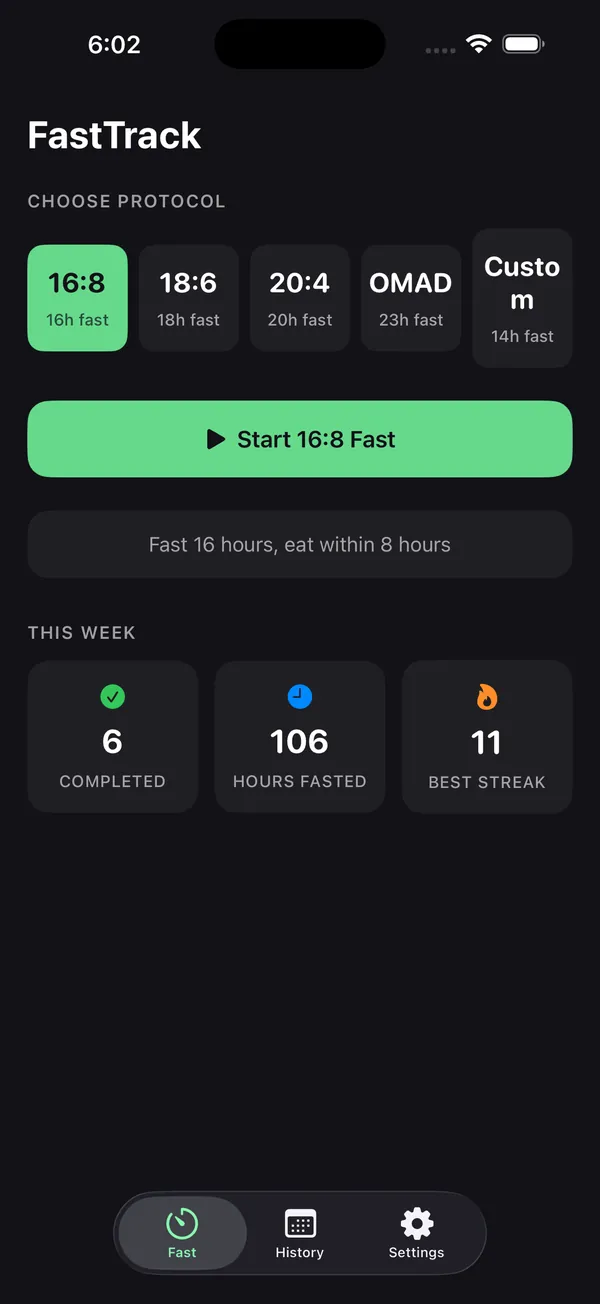
The clock math is the easy part, and the intermittent fasting calculator does it for you.
- OMAD 23:1: eat from 6:00 pm to 7:00 pm.
- 20:4: eat from 3:00 pm to 7:00 pm.
- The difference is 3 hours of eating time, and whether you need all your food at one sitting.
What the evidence says about OMAD benefits
One controlled trial is a small pilot study by Stote and colleagues, a crossover of two 8-week periods in healthy, normal-weight adults who ate their maintenance calories in either 3 meals or 1 meal a day. In that trial, the one-meal diet brought "a significant modification of body composition, including reductions in fat mass". It also brought a "significant increase in hunger" and "significant increases in blood pressure and in total, LDL-, and HDL-cholesterol concentrations".
So the honest summary is mixed: less fat mass, more hunger, and higher blood pressure and LDL cholesterol. It was a small pilot in healthy people, so it cannot tell you what OMAD does for you. Harvard's review of intermittent fasting still lists "What are the long-term effects of intermittent fasting?" as an unanswered question.
Who should not try OMAD
Harvard's review says people with diabetes, eating disorders that involve self-restriction, or who use medication that requires food should abstain from intermittent fasting. So should adolescents and people who are pregnant or breastfeeding. The Cleveland Clinic guide adds that fasting "has also been known to increase the likelihood of binge eating or orthorexia in some people". A single daily meal raises those stakes, so talk to a clinician before you try it.
OMAD meals: how to plan the one plate
With one meal, there is nowhere to catch up later. Plan protein, vegetables and enough total food. This plate uses USDA figures per 100 g for roasted chicken breast, dry white rice and raw broccoli.
| Food | Amount | Calories | Protein |
|---|---|---|---|
| Roasted chicken breast | 200 g cooked | 330 | 62 g |
| White rice | 100 g dry | 365 | 7 g |
| Broccoli | 200 g raw | 68 | 6 g |
| Total | 763 | 75 g |
- The sample plate above is 763 calories.
- US nutrition labels use 2,000 calories a day as a general reference.
- 2,000 minus 763 leaves 1,237 calories that plate does not cover.
- If you are not trying to eat less, one normal plate falls well short.
This is arithmetic, not a meal plan. Your needs depend on your body and activity, and a dietitian can help you fill the gap safely.
- Goal: 74 fl oz of drinks, the National Academies figure for women.
- None of it comes with meals during the first 23 hours, so spread it out.
- Six 12 fl oz glasses between 8:00 am and 6:00 pm gets you to 72 fl oz.
If you want to try it, step up slowly
You do not need to jump straight to one meal. Try the 16:8 schedule first, and go shorter only if it is going well.
- Week 1: 16:8, eating 12:00 pm to 8:00 pm.
- Week 2: 18:6, eating 2:00 pm to 8:00 pm.
- Week 3: 20:4, eating 4:00 pm to 8:00 pm.
- Only then one meal, if you still want it and your clinician agrees.
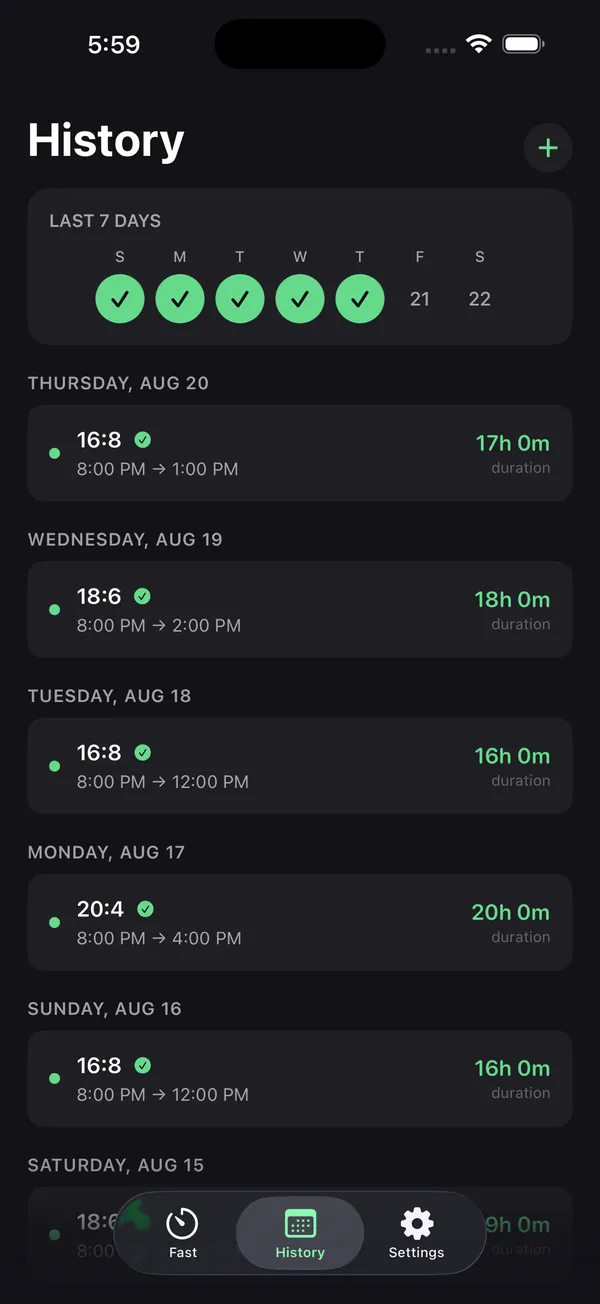
FastTrack tracks these windows on your iPhone. The 16:8, 18:6 and 20:4 timers are free, and OMAD (23:1) and custom windows are part of Premium. Wondering what you can drink during those 23 hours? See does coffee break a fast.
What the OMAD trial did and did not test
That study is often used as evidence for OMAD, so its limits matter. Three details change how far you can take it.
- The "one meal" lasted up to four hours. The paper says the food was "eaten within a 4-h period in the early evening." That is closer to 20:4 than to a true one-hour 23:1.
- It was very small. "Twenty-one subjects (14 women, 7 men) ultimately were randomly assigned to the treatments", and 15 completed the feeding phase.
- It held calories steady. Food was set at an energy intake to maintain weight, so it does not tell you what happens when OMAD also means eating less, which is how many people try it.
So a strict one-hour OMAD has even less direct evidence than the study suggests. Harvard's bottom line on intermittent fasting generally is: "It is unclear that intermittent fasting is superior to other weight loss methods in regards to amount of weight loss, biological changes, compliance rates, and decreased appetite."
OMAD compared with other fasting schedules
| Schedule | Eating time | Meals that fit | In FastTrack |
|---|---|---|---|
| 16:8 | 8 hours | 2 or 3 | Free |
| 18:6 | 6 hours | 2 | Free |
| 20:4 | 4 hours | 1 large, 1 small | Free |
| OMAD 23:1 | About 1 hour | 1 | Premium |
Before choosing OMAD, it is worth asking what you want from it. If the appeal is simplicity, a 20:4 window gives you most of that, with a second chance to eat. If you already eat once a day out of habit, Harvard notes that people "who typically eat one or two meals a day" may show better compliance with this kind of plan. That is about sticking to it, not about health results.
More OMAD meal ideas, with real numbers
All three plates below use USDA figures per 100 g. They are examples of how to count, not a prescription. Each is built around protein, fiber and enough total food.
| Food | Amount | Calories | Protein |
|---|---|---|---|
| Salmon, cooked | 200 g | 412 | 44 g |
| Lentils, cooked | 200 g | 232 | 18 g |
| Avocado | 100 g | 160 | 2 g |
| Olive oil | 14 g | 124 | 0 g |
| Total | 928 | 64 g |
| Food | Amount | Calories | Protein |
|---|---|---|---|
| Hard-boiled eggs (4 large) | 200 g | 310 | 25 g |
| Oats, dry | 80 g | 303 | 11 g |
| Broccoli, raw | 200 g | 68 | 6 g |
| Avocado | 100 g | 160 | 2 g |
| Total | 841 | 43 g |
| Food | Amount | Calories | Protein |
|---|---|---|---|
| Chicken breast, roasted | 250 g | 412 | 78 g |
| White rice, dry | 100 g | 365 | 7 g |
| Lentils, cooked | 150 g | 174 | 14 g |
| Broccoli, raw | 150 g | 51 | 4 g |
| Olive oil | 14 g | 124 | 0 g |
| Total | 1126 | 102 g |
Notice how much food that is. Even these full plates fall short of the 2,000 calorie reference on US Nutrition Facts labels. That is a general reference, not your personal need, but it shows why one sitting makes it hard to eat enough, and why a dietitian is worth asking if you plan to keep this up.
Choosing when to have your one meal
Most people picture OMAD as a late dinner, but any time works on the clock. Choose by what you can keep up, and by when you need your energy.
- Fits a family dinner.
- The fast runs through the whole workday.
- Harder if your day is physical or you train in the afternoon.
- Fits a work lunch.
- The fast runs from 2:00 pm until 1:00 pm next day.
- You skip dinner, which is often the hard part socially.
- Today's meal finished at 7:00 pm.
- Tomorrow you have a noon lunch you cannot move.
- 7:00 pm to 12:00 pm is 17 hours, not 23.
- That day is simply a 17-hour fast. Log it as it was.
What to drink during the 23 hours
The Cleveland Clinic guide says: "Zumpano says water, carbonated water, black coffee and unsweetened teas are all acceptable" when fasting. Because all your food comes at one time, you get less of the water that normally comes with meals, so drink through the day. The how much water to drink guide has the published figures.
Signs OMAD is not working for you
A plan that needs constant willpower rarely lasts, and it can hurt. The Cleveland Clinic warns about binge eating and orthorexia, and the Stote trial measured more hunger. Treat these as reasons to stop or to change plans, and to talk to a clinician:
- Your one meal keeps turning into eating past fullness, or feeling out of control around food.
- You think about food most of the day, or feel anxious about your schedule.
- You feel dizzy, faint or unwell. Stop fasting and get medical advice.
- A blood pressure or cholesterol reading gets worse. Tell your doctor that you are doing OMAD, as the trial saw both rise.
Going back to 16:8 or to normal meals is not a failure. It is the point of checking.
Questions people ask
What does OMAD stand for?
One meal a day. You eat once, usually in about a one-hour window, and fast for the other 23 hours. It is written as 23:1 in fasting apps.
Is OMAD healthy?
The evidence does not settle it. In a small trial of healthy adults, one meal a day, eaten within four hours, reduced fat mass but raised hunger, blood pressure and LDL cholesterol. Harvard's review lists long-term effects as unanswered. Ask a clinician first, especially with any health condition.
Can you lose weight on OMAD?
The trial was built to keep weight stable, and subjects stayed within 2 kg of their starting weight, so it does not answer that directly. One meal can also make it harder to fit in all the food you need.
What is the difference between OMAD and 20:4?
OMAD gives you about one hour to eat, 20:4 gives you four. On 20:4 you can have two small meals. On OMAD all your food must fit in one sitting.
Can I drink coffee on OMAD?
Black coffee, water, carbonated water and unsweetened tea are listed by Cleveland Clinic as acceptable when fasting. Milk, sugar and cream add calories.
Sources
- Stote et al.: A controlled trial of reduced meal frequency
- Harvard T.H. Chan: Diet Review, Intermittent Fasting
- Cleveland Clinic: Intermittent fasting, 4 different types
- USDA: Chicken breast, roasted
- USDA: White rice, raw
- USDA: Broccoli, raw
- FDA: How to understand and use the Nutrition Facts label
- USDA: Salmon, cooked
- USDA: Lentils, cooked
- USDA: Avocado
- USDA: Olive oil
- USDA: Eggs, hard-boiled
- USDA: Oats, dry
Guides
- A 16:8 intermittent fasting scheduleA 16:8 intermittent fasting schedule with clock times for early risers, 9-to-5, night shifts and weekends, a 12:12 ramp-up week and what the evidence says.
- 18:6 intermittent fasting18:6 intermittent fasting means fasting 18 hours and eating in a 6-hour window. See sample schedules, how it compares to 16:8, and who should avoid it.
- 20:4 intermittent fasting20:4 intermittent fasting means fasting 20 hours and eating within 4. See sample schedules, how it differs from OMAD, the evidence and who should avoid it.
- Best foods to break a fastThe best foods to break a fast are ordinary: protein, fiber and whole grains. See three meals with USDA numbers, what to limit and long-fast cautions.
- Does bone broth break a fast?Does bone broth break a fast? Under a strict rule, yes: it has calories and protein. See USDA figures, how to read a carton, and when to drink it instead.
- Does coffee break a fast?Does coffee break a fast? An order-by-order table for black coffee, milk, latte, cream, bulletproof and sweeteners, with USDA calories and worked mornings.
- Does creatine break a fast?Does creatine break a fast? Plain creatine is unlikely to, but gummies, flavored powders and pre-workouts can. How to read the label and when to take it.
- Does gum break a fast?Does gum break a fast? Sugared gum does, and sugar-free gum is a gray area with a few calories and sweeteners. See the label math and what to use instead.
- Does lemon water break a fast?Does lemon water break a fast? A wedge is about 1 calorie and a whole lemon about 11. See the USDA table, strict and relaxed rules, and the lab exception.
- Does stevia break a fast?Does stevia break a fast? Pure stevia has almost no calories, but it is still a gray area and packets often hide fillers. How to read the label and decide.
- A fasting app without a subscription wallLooking for a fasting app without a subscription? What a free intermittent fasting tracker should include, the traps, and what FastTrack keeps free.
- Fasting before blood workFasting before blood work: which tests need it, the hours Labcorp, Quest and MedlinePlus give, and seven timelines from your last meal to the draw.
- Intermittent fasting calculatorA free intermittent fasting calculator: pick 16:8, 18:6, 20:4 or OMAD, enter your last meal, and see when your fast ends and your window opens.
- Keto and intermittent fastingKeto and intermittent fasting can be combined, but no strong evidence shows it's better. See what each does, a sample day, risks and who should avoid it.
- A Simple fasting app alternativeLooking for a Simple fasting app alternative? Compare apps by their own listings, what you give up without a coach, and how to cancel and move across.
- What breaks a fast?What breaks a fast? Anything with calories, by the strict rule. See one table of drinks, sweeteners and supplements, plus what to do if you slip up.
- A Zero fasting app alternativeLooking for a Zero fasting app alternative? What Zero includes free and in Zero Plus, by its own App Store listing, next to FastTrack's free tier.